
You have probably seen the debate: GPT-4o vs Claude Opus vs Gemini. Which model is smarter? Which benchmark does it beat? Teams spend weeks on this question, swap models, run more tests, and then wonder why their AI agent still breaks in production.
- What Is an Agent Harness?
- Why Did Agent Harnesses Emerge?
- Real-World Harnesses You Already Know
- How an Agent Harness Actually Works
- The Core Components of an Agent Harness
- Memory
- Tool Management
- Context Engineering
- Guardrails: Guides and Sensors
- Human-in-the-Loop Controls
- Orchestration
- Agent Harness vs Agent Framework vs Runtime
- Harness Engineering: A New Discipline
- Does the Model Matter at All?
- How to Start Building a Harness
- The Broader Picture: What Harnesses Mean for AI Products
- FAQs About Agent Harnesses
- Is an agent harness the same as a prompt?
- Do I need a harness for every AI application?
- Can multiple models share the same harness?
- What is the difference between context engineering and harness engineering?
- How long does it take to build a production-ready harness?
- Is LangChain a harness?
- Conclusion
The engineers who actually ship reliable AI systems have figured something out: the model is rarely the problem. The infrastructure around it is.
That infrastructure has a name now. It is called an agent harness.
This guide covers what agent harnesses are, how they work under the hood, why they emerged, what they are made of, and why 2026 is shaping up to be the year where the harness matters more than the model.
What Is an Agent Harness?
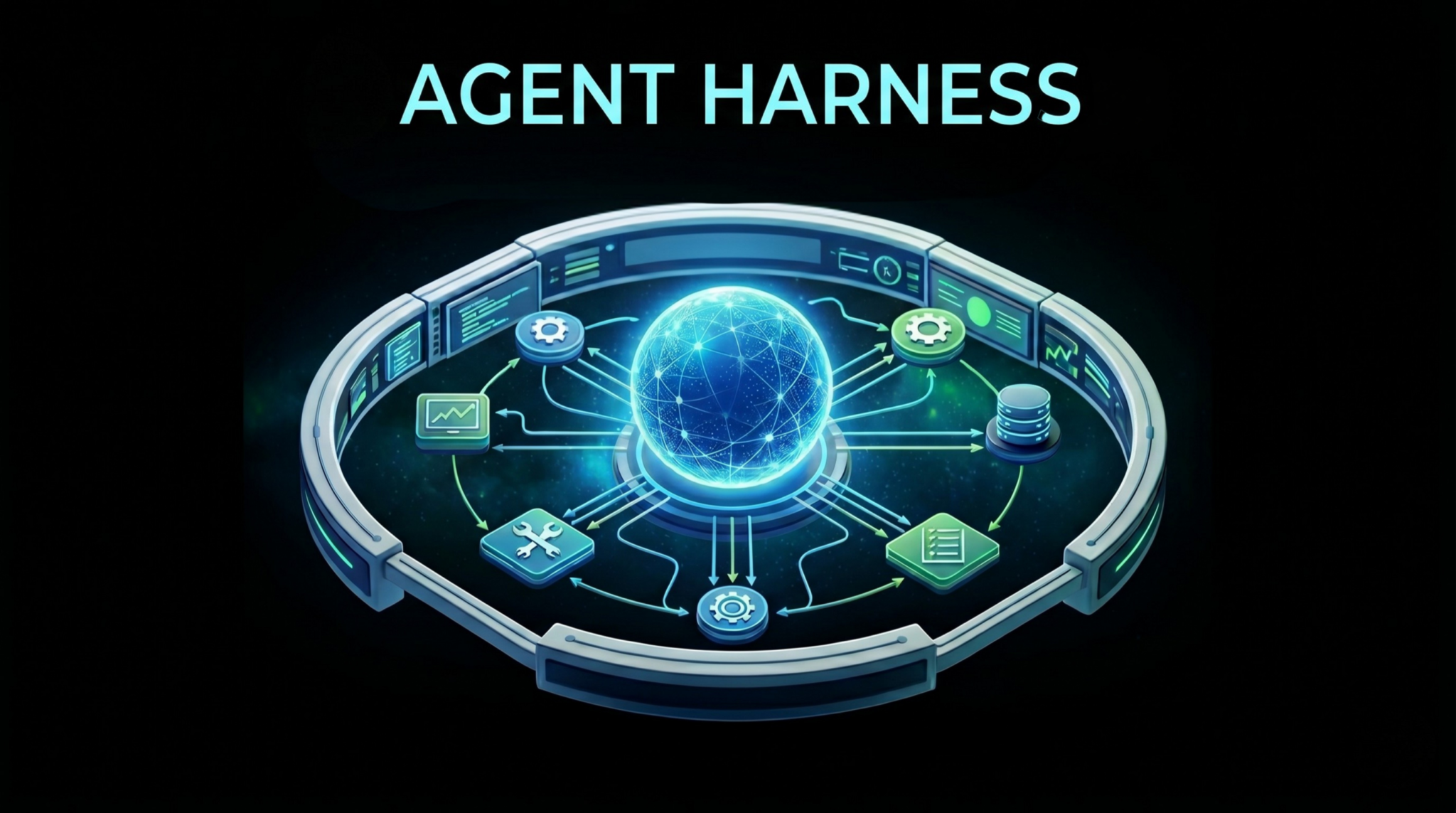
An agent harness is the software infrastructure surrounding an AI model that manages everything except the model’s actual reasoning. It acts as the intermediary between the LLM and the outside world, handling tool execution, memory storage, state persistence, and error recovery.
The simplest formula to remember: Agent = Model + Harness
The term harness has emerged as a shorthand to mean everything in an AI agent except the model itself. The model generates responses. The harness handles everything else.
Think about it this way. A car engine produces power. But an engine sitting in a field goes nowhere. You need steering, brakes, fuel delivery, sensors, and a chassis before it becomes useful. The model is the engine. The harness is the car. The best engine without steering and brakes goes nowhere useful.
This is not a theoretical distinction. It has real production consequences. Manus rewrote their harness five times in six months. Same models. Five architectures. Each rewrite improved reliability and task completion. The model did not change. The harness did. LangChain re-architected Deep Research four times in one year, not because models improved, but because they discovered better ways to structure workflows, manage context, and coordinate sub-tasks.
Why Did Agent Harnesses Emerge?
Early AI products were simple. You sent a prompt, you got a response. A chatbot is the clearest example: one input, one output, no memory of what happened before, no ability to act in the world.
Harnesses emerged to solve practical challenges as AI agents took on more complex, long-running, and tool-oriented tasks. Modern AI agents are asked to do things that go beyond a single prompt-response exchange: writing software projects over multiple sessions, querying databases or web APIs, analyzing large documents, or interacting with a user interface.
The core problem is that LLMs are stateless by default. Every new session starts from scratch. There is no memory of the last conversation, no awareness of what tools were called, no record of what succeeded and what failed. For a simple chatbot, this is acceptable. For an agent completing a week-long software project, it is a fatal limitation.
In summary, harnesses became necessary as AI moved from one-shot interactions to persistent, tool-using, multi-step autonomy. They address the “glue” issues: memory beyond the context window, interfacing with external systems, and structuring multi-step work that pure LLMs alone were not designed to handle.
Real-World Harnesses You Already Know
The concept might feel abstract, but you have almost certainly used a harness.
Claude Code and Codex CLI are essentially agentic coding tools that wrap an LLM in an application layer, a so-called agentic harness, to be more convenient and better-performing for coding tasks. Coding agents are engineered for software work where the notable parts are not only the model choice but the surrounding system, including repo context, tool design, prompt-cache stability, memory, and long-session continuity.
What broke out with Claude Code was not Claude alone. It was Claude Code. Because Claude Code is a better harness wrapped around the same model. The model inside it is the same one you can access through the API. What makes it significantly more capable for coding is what wraps around that model: file access, terminal execution, session memory, error recovery, and context management.
Anthropic’s computer use feature demonstrates this too. The model generates actions. The harness controls what is allowed, validates actions, and manages human intervention.
The harness is the product. The model is a component inside it.
How an Agent Harness Actually Works
An agent harness typically works by intercepting and augmenting the communication between the user, the AI model, and any external tools or environments. The user’s request or high-level goal is captured, and an orchestrator breaks this goal into sub-tasks or decides on a sequence of actions the AI should take. The harness works closely with this orchestrator by providing it the means to execute those actions.
Let us walk through what happens step by step when you give an agent a complex task.
Step 1: Intent capture. The harness receives your goal. It may parse it, break it into sub-tasks, and create a plan. This is not the model reasoning on its own; the harness scaffolds the reasoning process by structuring what the model receives.
Step 2: Context assembly. Before the model sees anything, the harness decides what context to include. What happened in the last session? What files are relevant? What tools are available? The harness assembles the context window deliberately.
Step 3: Tool execution. The model decides it needs to call a tool (search the web, run code, read a file). The harness intercepts this call, executes it against the real system, handles errors if the tool fails, and returns structured results back to the model.
Step 4: State persistence. After each action, the harness saves state. When the session ends, it records what happened so the next session can pick up from the right point. Without this, every restart is a blank slate.
Step 5: Guardrails and verification. Before the agent takes a consequential action (delete a file, send an email, charge a card), the harness evaluates whether that action is allowed. Some actions require human approval. The harness enforces this.
Step 6: Error recovery. When something breaks, the harness does not just crash. It logs the failure, determines whether to retry, escalates to a human if needed, and records the failure pattern so it can be prevented in the future.
The Core Components of an Agent Harness
A complete harness consists of the LLM, tools, a planning loop, context engineering, a sandbox, memory, an orchestration layer, and a serving layer. Let us break each one down.
Memory
Memory is what makes an agent feel intelligent across sessions instead of amnesiac.
There are generally three types of memory in a harness:
In-context memory is what lives inside the current prompt window. The harness decides what to include: recent conversation history, relevant documents, prior tool results. This is a curation problem. Stuffing everything into context makes the model worse, not better. The harness curates.
External memory is what lives outside the model: a vector database, a key-value store, a file system. The harness queries this when relevant and writes back when something important needs to be remembered long-term.
Procedural memory is about what the agent has learned to do. Some emerging harness architectures are experimenting with storing successful action sequences so the agent can reuse them. Think of it as the agent building its own playbook over time.
Tool Management
Tools are how the agent interacts with the world. Without tools, the model can only produce text. With tools, it can run code, read files, search the web, call APIs, and interact with UIs.
The harness manages tool access carefully. Vercel removed 80% of their agent’s tools and got better results. Fewer tools meant fewer steps, fewer tokens, faster responses, and higher success. Harness improvement through subtraction.
This is counterintuitive. More tools feel like more capability. But every tool the agent has access to is also a source of decision overhead, errors, and confusion. Good harness design means giving the agent exactly the tools it needs for the task, no more.
Context Engineering
Context engineering is the practice of deciding what information goes into the model’s context window at each step. It is not just about what you put in the prompt. It is about sequencing, relevance, and compression.
By context engineering we mean designing the immediate prompt and retrieved context for a single call; a harness subsumes this, but also manages multi-step structure, tool mediation, verification, and durable state.
The harness is the layer that makes context engineering operational at scale. It is one thing to manually craft a great prompt. It is another to have a system that automatically assembles the right context for each step of a 50-step task.
Guardrails: Guides and Sensors
This is where harness engineering gets genuinely interesting. To harness a coding agent we both anticipate unwanted outputs and try to prevent them, and we put sensors in place to allow the agent to self-correct. Guides (feedforward controls) anticipate the agent’s behaviour and aim to steer it before it acts. Sensors (feedback controls) observe after the agent acts and help it self-correct.
Guides are proactive. They are instructions, constraints, and context built into the harness that make good outcomes more likely before the model acts. Examples: a coding style guide in the system prompt, an allowed-actions list, templates for output format.
Sensors are reactive. They check outputs after the fact. Examples: a linter that checks generated code, a test runner that validates the agent’s output, an “LLM as judge” pattern that evaluates semantic quality.
Computational sensors catch structural problems reliably: duplicate code, cyclomatic complexity, missing test coverage, architectural drift, style violations. These are cheap, proven, and deterministic. Inferential controls, meaning those powered by an LLM, allow additional semantic judgment, but are more expensive and non-deterministic.
The best harnesses combine both. Cheap computational sensors run on every action. Expensive inferential sensors run at decision checkpoints.
Human-in-the-Loop Controls
Agents pause at critical decisions. Delete a database? Charge a card? Send customer emails? The harness requires approval.
Human-in-the-loop is not a sign of an immature harness. It is a feature of a mature one. The harness defines exactly which actions require human review, routes those approvals to the right person, and logs the outcome. Over time, as confidence in the agent grows, more actions can be automated. But the harness makes this a deliberate, traceable decision rather than an accidental one.
Orchestration
For complex tasks, a single agent is not enough. You need multiple agents working in sequence or in parallel, each specializing in a part of the problem.
For complex projects, the harness dispatches specialist agents (researcher, writer, reviewer), managing handoffs so each agent gets relevant context from the previous step without irrelevant history.
The orchestration layer of the harness handles routing, context handoff, result aggregation, and failure recovery across agents. Without it, multi-agent systems become a coordination mess.
Agent Harness vs Agent Framework vs Runtime
These three terms get confused constantly. Here is the distinction.
LangChain, LlamaIndex, and Microsoft Semantic Kernel are agent frameworks offering rich abstractions for LLMs and tools. LangGraph and Temporal are runtimes: production-ready systems for durable agent execution with strong fault tolerance.
The harness sits at a different level. It is the task-specific layer that wraps around the model for a particular application. A framework gives you building blocks. A runtime handles execution durability. A harness is the assembled system you actually deploy for a specific purpose.
You can build a harness using a framework. You can run it on a runtime. But neither the framework nor the runtime is the harness itself. The harness is what you build with them.
Harness Engineering: A New Discipline
The term “harness engineering” gained formal traction in early 2026. Mitchell Hashimoto published a post in February 2026 formalizing what practitioners had been building informally for years. Days later, OpenAI documented how a three-engineer team used harness engineering to produce a million-line codebase at 3.5 pull requests per engineer per day.
Harness engineering treats agent failures as system problems, not prompt problems. Each failure mode produces an update to the instruction file or a new tool. The harness makes correctness mechanically enforced rather than verbally requested.
This is the mental shift that separates teams that ship from teams that demo. When an agent fails, the instinct is to improve the prompt. Harness engineers ask a different question: what change to the system would make this class of failure impossible in the future?
Most engineering teams obsess over which model to use. They debate GPT-4o versus Claude Opus versus Gemini. They chase benchmark scores and swap models, hoping for better results. When a financial AI startup stripped everything back to plain Python, simple API calls, and a custom engine, things finally worked. What they accidentally built was a harness featuring specialized financial tools, domain-specific guardrails, and purpose-built context engineering. They did not know the term yet, but the lesson was clear. The model was never the problem. The system and infrastructure around it were.
Does the Model Matter at All?
Yes, but less than most teams assume.
The model determines the ceiling. A better model can reason more accurately, handle more nuanced instructions, and make fewer errors in judgment. But the harness determines whether you ever get close to that ceiling in production.
In academic research, a harness that allowed a single LLM to play diverse games by plugging in perception, memory, and reasoning modules improved win rates across all tested games compared to an unharnessed baseline model. The harnessed model consistently outperformed the same model without a harness, because the harness gave it hands (to act in the game) and memory (to remember state).
The same model, with and without a harness, produces meaningfully different results. That tells you the harness is not marginal. It is core.
You can fine-tune a competitive model in weeks. Building production-ready harnesses takes months or years. Companies investing in harness engineering now build advantages that persist. The model is increasingly a commodity. Any team can access GPT-4-class intelligence through an API. What they cannot instantly replicate is the harness that makes that intelligence reliable, safe, and useful for a specific domain.
How to Start Building a Harness
You do not need to build everything at once. Pick one agent task that delivers value. Build the minimum harness to make it reliable. Deploy. Learn from production. Instrument everything: log every tool call, error, human intervention, and timeout. You cannot improve what you do not measure. Iterate based on failure modes. Each failure reveals a missing guardrail. Add the guardrail. Deploy. Find the next failure.
The practical order of operations:
Start with observability. Before you can improve anything, you need to see what is happening. Log every model call, every tool invocation, every failure, and every human override. This is not optional. You cannot debug a harness you cannot observe.
Add memory deliberately. Do not try to persist everything. Decide what the agent actually needs to remember across sessions and build exactly that. Start with a simple file-based session log. Move to a vector store only when retrieval quality becomes a real problem.
Define your guardrail boundaries early. Decide upfront which actions require human approval. Build that into the harness before you deploy. It is much harder to add safety controls retroactively when users are already relying on the system.
Treat tool count as a dial. Start with the minimum set of tools needed for the task. Add tools only when you have a clear failure mode that more tools would solve. More tools rarely improve reliability. They usually do the opposite.
Measure task completion, not token counts. The right metrics for a harness are did the agent complete the task correctly and how often did it need human intervention? Token usage, response speed, and benchmark scores are interesting. Task completion rate is what matters in production.
The Broader Picture: What Harnesses Mean for AI Products
There is a strategic implication here that product teams should think about carefully.
If the model is a commodity, and the harness is the moat, then AI product differentiation will increasingly come from harness quality, not model quality. Two products using the same underlying model can be wildly different in reliability, safety, and usefulness based solely on how well-engineered the harness is.
This is already playing out. Claude Code and the raw Claude API both use the same underlying model. Claude Code feels dramatically more capable for software work because the harness around it was engineered specifically for that context: file access, terminal integration, multi-turn session management, code-aware context selection.
2025 proved agents could work. 2026 is about making them work reliably at scale. That reliability is entirely a harness problem. The teams that understand this early will build durable product advantages.
FAQs About Agent Harnesses
Is an agent harness the same as a prompt?
No. A prompt is a single instruction to the model. A harness is a complete system that includes prompt templates, but also memory, tools, state management, error recovery, guardrails, and orchestration. Thinking about harnesses as “big prompts” misses most of what they do.
Do I need a harness for every AI application?
You do not need a harness for simple, single-turn tasks, but any multi-step or long-running work requires one. If your use case is a one-shot summarization or a simple question answering tool, a well-crafted prompt may be sufficient. If your agent needs to complete tasks across multiple steps, maintain context between sessions, or take actions in the world, you need a harness.
Can multiple models share the same harness?
Yes. Multiple models can share the same harness. The model is a pluggable component. This is actually a sign of a well-designed harness: one that is not tightly coupled to a specific model’s quirks, so you can swap the underlying model without rebuilding the whole system.
What is the difference between context engineering and harness engineering?
Context engineering is about what goes into the model’s context window for a single call. Harness engineering is broader: it covers multi-step structure, tool management, memory across sessions, state persistence, and error recovery. A harness subsumes context engineering, but also manages multi-step structure, tool mediation, verification, and durable state.
How long does it take to build a production-ready harness?
Longer than most teams expect. Manus spent six months on five rewrites. LangChain spent a year on four architectures. World-class teams with significant resources. Your timeline will be similar or longer. This is not a reason to avoid it. It is a reason to start with a minimal harness and iterate rather than trying to design the perfect system upfront.
Is LangChain a harness?
LangChain is a framework, meaning it gives you building blocks for constructing a harness. The harness is the specific system you build using those blocks. Many teams conflate the two because they use LangChain as their harness, but the distinction matters: the framework is generic infrastructure, the harness is purpose-built for your specific agent task.
Conclusion
The shift from “which model should we use” to “how should we build the system around the model” is the most important strategic reorientation happening in AI engineering right now.
Agent harnesses are not an advanced topic for researchers. They are the practical answer to why most AI agents fail in production: not because the model is insufficient, but because nothing around the model was engineered properly.
The model generates intelligence. The harness determines whether that intelligence does anything useful.
Build the harness. That is where the work actually is.